Offline PoC
Evidence lanes
Section titled “Evidence lanes”Observed shadow replay consumes the exact retained write-wait series and records controller decisions without changing history. The incident series is ZFS write total-wait; taking p95 across its samples does not turn it into a true I/O latency p95. It is pressure-proxy evidence, not production p95 calibration.
Counterfactual sensitivity replay caps derived demand by each proposed budget and evaluates conservative, nominal, and optimistic monotonic pool models. These outcomes are estimates, not production measurements.
Incident evidence assessment keeps event ordering and aggregate field checks outside the replay lane. Retained write-wait collection started 53 seconds after the management-failure marker. The pressure signature is visible one second after collection starts, but advance warning is not proven.
Read-only live baseline
Section titled “Read-only live baseline”A synchronized 30-second natural-load window on 2026-08-02 ran the proposed probe in memory over SSH stdin. It installed nothing and changed no host, service, alert, or limit. The anonymized aggregate found:
- ZFS write
total_wait: 12.784 ms median, 136.069 ms p95, and 153.569 ms maximum across 30 one-second interval means; - 10 interval means above 25 ms and 3 at or above 100 ms;
- member-disk average write wait at or below 20.100 ms across three derived intervals, with queue depth at or below 1.121;
- four successful management probes; detector v1 stayed at level 0.
This is a metric-layer observation, not proof of a missed incident: ZFS
total_wait and diskstats average wait have different layers and statistics.
The ZFS p95 is a percentile across interval means, not I/O p95. The window is
short, uncontrolled, not exactly workload-bound, and therefore ineligible as a
promotion trace. Raw identifiers were not retained in the repository.
Result
Section titled “Result”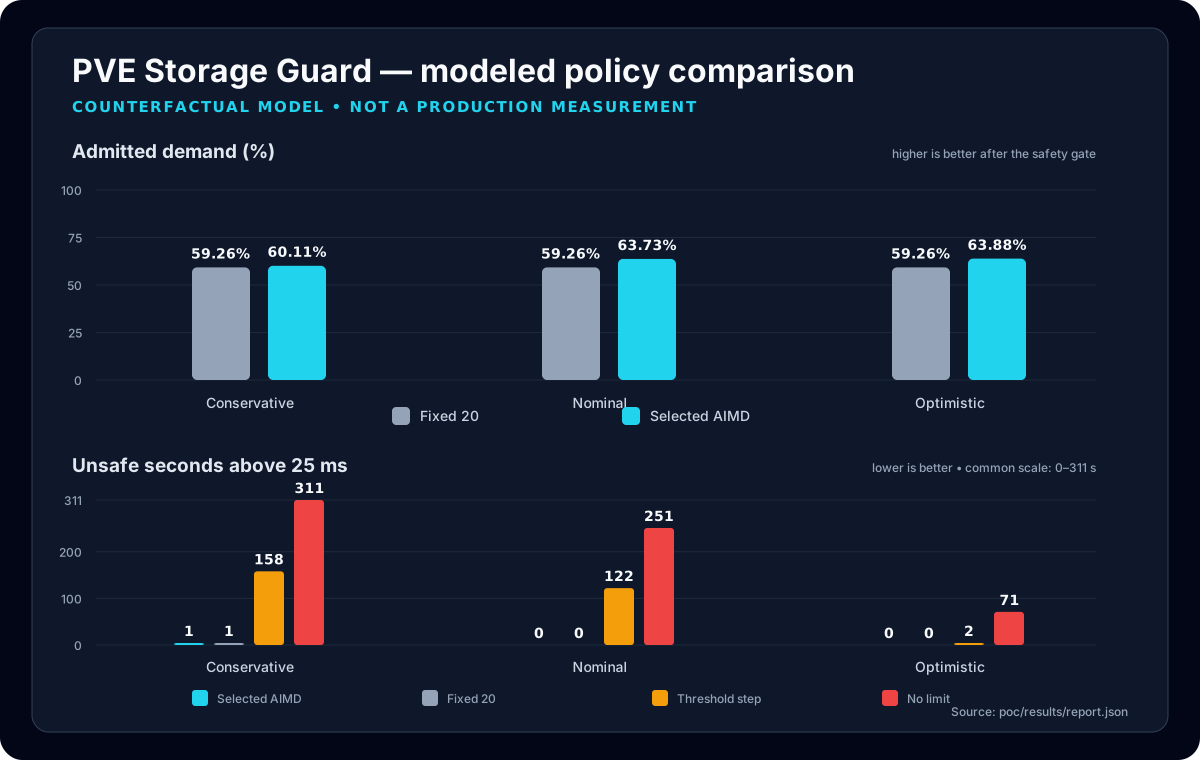
The SVG is regenerated from the reviewed PoC golden JSON in CI. It deliberately places admission beside unsafe seconds and labels itself as counterfactual, not a production measurement.
| Scenario | Fixed 20 admission | Selected AIMD admission | Unsafe seconds (both) |
|---|---|---|---|
| Conservative | 59.26% | 60.11% | 1 |
| Nominal | 59.26% | 63.73% | 0 |
| Optimistic | 59.26% | 63.88% | 0 |
The threshold-step controller caused 158 unsafe seconds in the conservative model and is rejected. Of 972 searched AIMD policies, 198 passed the cross-model safety constraint.
Evidence gaps
Section titled “Evidence gaps”The historical store did not retain one-second PSI, queue, IOPS, or SSH/API probes. The twelve write-wait samples are an incident window, not a baseline. One incident cannot establish defaults for SSD, HDD, Ceph, or network storage. Two other local windows survive only as same-episode aggregate summaries, so they cannot be replayed or counted as an independent trace. The replay trace contract keeps source kind, statistic, completeness, and independence explicit.
A later fixed-20 natural-load check had 22 of 60 samples above 25 ms and a 234.065464 ms p99. Controlled load was not started; the cap was rejected and rolled back. The recommendation is shadow-only. Fixed 20 MiB/s is a model comparator, not a validated production fallback.